Polyester and nylon filament yarns: FDY, DTY, POY and ATY without the jargon
The quote says “polyester DTY,” but the development fabric feels flatter than the swatch you approved. Has the yarn changed, or is the difference coming from knitting, dyeing or finishing? The abbreviation alone cannot answer that. For an apparel buyer, it is a starting point for a specification—not a promise of a particular handle.
Understanding four common filament-yarn labels helps you ask better questions. The aim is to connect the yarn description to an identifiable fabric sample, then check whether that sample suits your garment.
Start with the polymer, then filament or staple
Polyester and nylon describe different polymer families. For polyester, confirm whether the reference is PET. Nylon is polyamide; identify PA6 or PA66 only when the supplier's documentation confirms the exact material. Neither family is universally softer, stronger or better for sportswear: yarn design, fabric construction and finishing all influence the outcome.
A filament is a continuous strand. A multifilament yarn brings many individual filaments together into one yarn. Staple fibres are shorter lengths spun together; polyester and nylon can also be supplied in staple form. A textured filament yarn may feel more like a spun yarn, but texturing does not make it a staple yarn.
FDY: fully drawn yarn
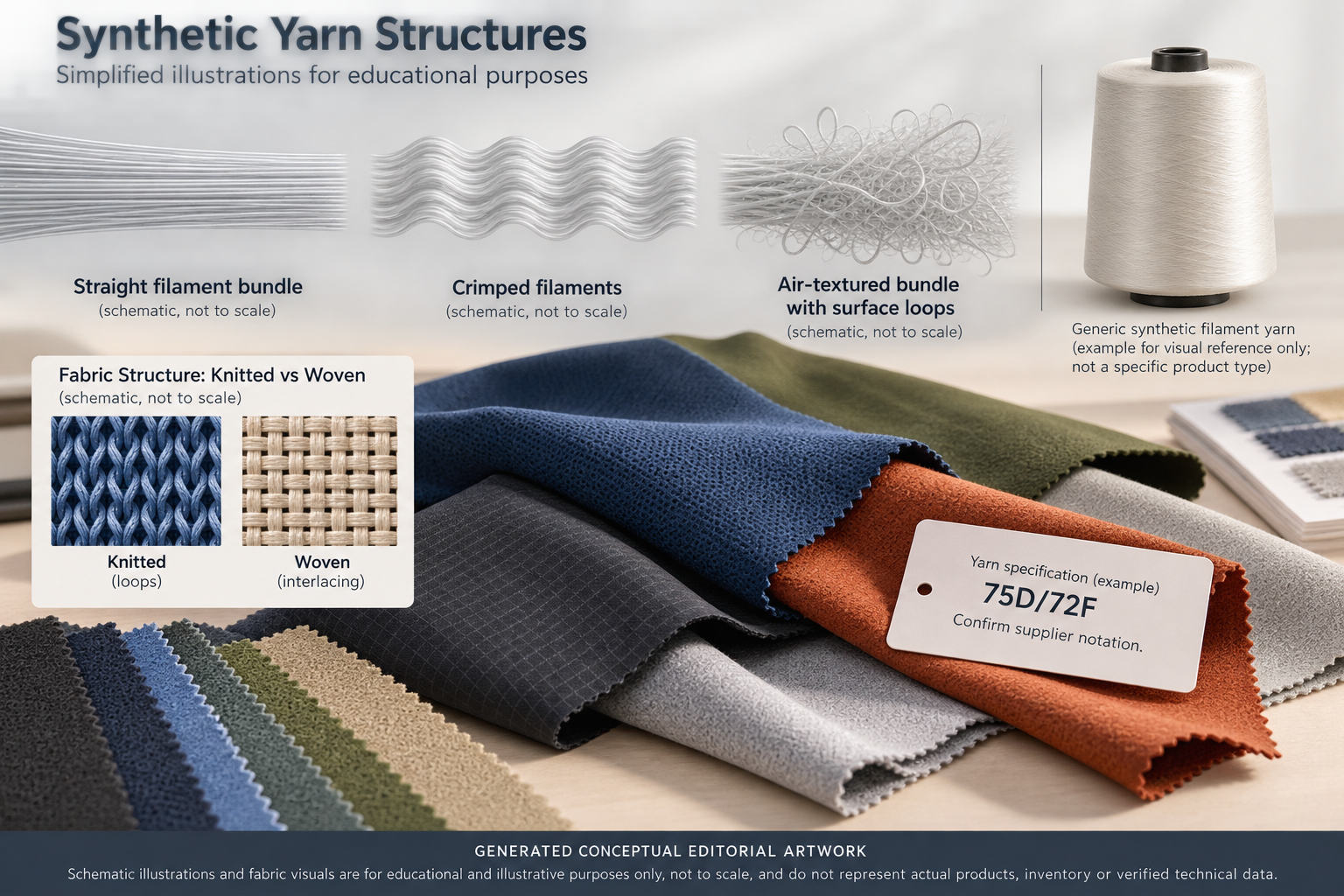
FDY means fully drawn yarn. Drawing stretches and orients the filaments during manufacture. FDY generally provides a relatively straight, smooth filament structure before any subsequent texturing or other processing.
In a fabric, this can contribute to a clean surface or fluid appearance, but lustre and handle also depend on filament cross-section, dulling, yarn size, construction and finish. “FDY” does not establish abrasion resistance, strength or snagging performance for a finished fabric.
POY: partially oriented yarn
POY means partially oriented yarn. It is commonly an intermediate intended for further drawing and processing, including conversion into draw-textured yarn. It should not be read as interchangeable with FDY or DTY.
If POY appears on a fabric quotation, ask what the designation describes: the upstream feed yarn or the yarn actually used in the fabric. A finished-fabric buyer needs the final yarn specification and an explanation of any subsequent processing, rather than just the starting material's name.
DTY: draw-textured yarn
DTY means draw-textured yarn. It is commonly produced by drawing and texturing POY, often using a false-twist process that introduces crimp. That crimp can add bulk, change light reflection and contribute to a less flat handle.
The effect varies with processing and fabric design. DTY does not automatically mean a soft, opaque or highly stretchable fabric. Crimp-related give is also not equivalent to elastane-based stretch and recovery. For fitted sportswear, evaluate extension and recovery on the actual fabric and garment rather than choosing by abbreviation.
ATY: air-textured yarn
ATY means air-textured yarn. Air jets create loops and entanglements within the filament bundle, potentially producing a bulkier, more spun-like surface. Feed yarn selection and processing conditions influence the result.
These small yarn-surface loops are not the structural loops of a knitted fabric. ATY can be used in different fabric constructions, and its name does not prove resistance to pilling or snagging. If a textured surface is important to your design, check it after handling and laundering, not only on a fresh presentation swatch.
Read yarn size alongside filament count
Denier and dtex both describe linear density: denier is grams per 9,000 metres of yarn; dtex is grams per 10,000 metres. They are not the same numerical scale. Filament count tells you how many individual filaments make up a multifilament yarn.
For example, “75D/72F” commonly indicates a total yarn size of 75 denier with 72 filaments, but confirm the supplier's notation. At equal total yarn size, a higher filament count means finer individual filaments. That can influence handle, but does not guarantee softness once construction and finishing are included. Request both figures, not simply “fine yarn.”
Check the fabric and the finished garment
Knitted fabrics are built from intermeshing yarn loops; woven fabrics use interlaced yarn systems. The same yarn designation can therefore appear in fabrics with very different movement, cover and surface character. Ask for the knit or weave construction, composition, weight, width and finish alongside the yarn details.
Compare the approval swatch and development sample under the same lighting and conditioning. Check drape, surface shine, bulk, opacity under extension and directional stretch. Record sample references and ask whether yarn specification, construction, dyeing or finishing changed. Hand feel alone cannot identify the cause.
Then make a garment prototype. Inspect seam puckering, needle damage, rubbing zones and whether panels grow or recover during movement. Evaluate laundering against the intended care instructions. Different tests address different failures: abrasion, pilling, snagging, dimensional change and colourfastness are separate questions. Agree documented methods and acceptance criteria appropriate to the end use; a yarn label is not a laboratory result.
A practical enquiry checklist
When contacting SINJO, send your reference swatch and intended garment use. Treat FDY, DTY, POY and ATY as possible yarn routes to discuss—not confirmed stock or evidence of in-house spinning. Ask for:
- Confirmed polymer, composition and exact final yarn designation.
- Denier or dtex, filament count, and yarn details by fabric direction where relevant.
- An explanation of how texturing and finishing affect the proposed hand and appearance.
- Construction, weight, width and a traceable sample reference.
- A development sample, garment-trial plan and agreed verification methods before approval.
Use the development enquiry to describe the mismatch you need to resolve, including what feels different from your approved swatch.