
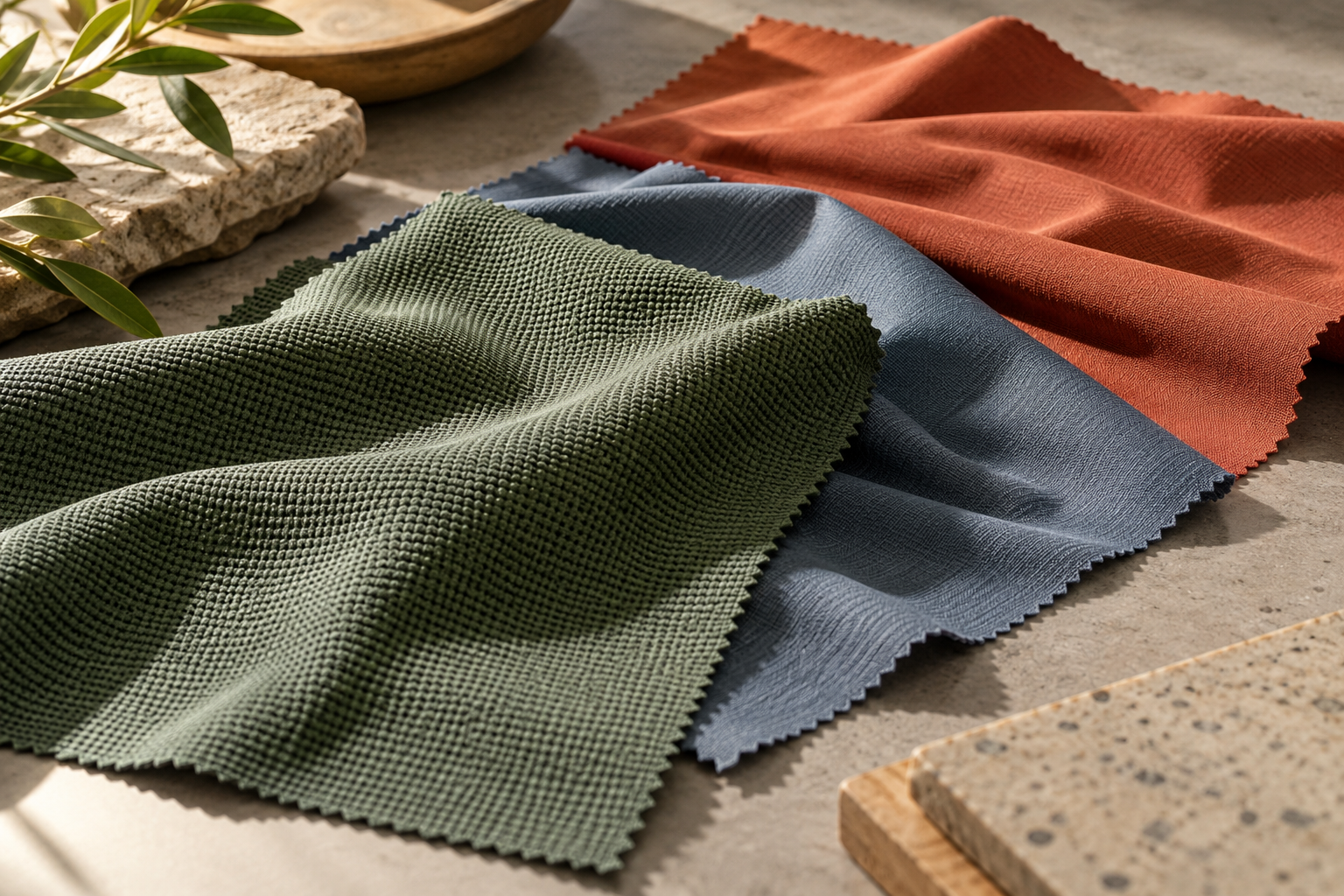
How to Approve Fabric Colour: Lab Dips, Light Sources and ΔE CMC
Your approved lab dip looks right in the development room, but the bulk dye lot appears greener in daylight or warmer under store lighting. That difference is not automatically evidence of a dye-house error. It may reflect a changed reference, a different fabric surface, inconsistent sample presentation, or metamerism between two samples. A reliable approval process links one physical colour standard to the actual fabric, agreed viewing conditions, documented measurements and the finished garment.
This applies to both polyester/PET and nylon/polyamide fabrics. Neither fibre is automatically better for colour matching. A knitted fabric is formed from intermeshing loops, while a woven fabric is made from interlaced yarns. Lustre, texture, density, stretch, heat setting and finishing can all affect the colour seen by the eye. A fibre label or yarn abbreviation is not a garment-quality guarantee.
Start with one controlling colour reference
Before requesting development, decide which physical item controls the colour decision. It may be a colour-library swatch, an approved fabric cutting or a retained production sample. Record its colour code, version, material, face side, finish and approval date. Give it a traceable identifier, such as COLOUR-STD-2026-014, version 2, and require that identifier on every lab dip, shade band, test report and approval record.
A digital file or screen image may support the physical reference, but it should not silently replace it. Screens vary with display settings and viewing conditions. Protect the signed reference from dirt, excessive handling and unnecessary light exposure. If the reference changes, withdraw the earlier version in writing so the supplier and buyer are not comparing different targets.
Match the development submission to the production article
A lab dip is a small dyed submission for developing a solid colour. Ask for it on the intended production fabric, with the planned finish represented where possible. A substitute base may be useful for early development, but it should be identified as a limitation and followed by confirmation on the actual production article before bulk release.
For a printed design, request a strike-off rather than relying on a solid-colour lab dip. Check the ground colour, print coverage, registration, adjoining colours and artwork scale on the relevant substrate. A matching solid base does not approve the complete print. Link the strike-off to the artwork version, fabric reference and submission identity, for example STRK-2026-014-A03.
Agree the viewing conditions before approval
Place the reference and submission together under controlled conditions. Keep the fabric face, orientation, backing, number of layers, neutral surround and viewing distance consistent. A lightweight fabric over a white table can look different from the same fabric over a dark lining or folded into several layers. On a garment, seam tension, stretch, panel direction and layer count can change the appearance again.
Specify the primary and secondary light sources before production. “Daylight” is not precise enough for repeatable approval; identify the agreed daylight simulator or controlled daylight arrangement. If retail appearance matters, describe the relevant store-light condition as far as practical instead of recording only “LED”. Review the pair under each agreed source separately and state whether agreement under the secondary source is mandatory or triggers escalation.
Metamerism is the situation in which two samples appear similar under one light but separate under another because their spectral reflectance differs. Consistent references, presentation and viewing sequences help identify and compare the problem; they do not cure it. If a required secondary light reveals a mismatch, do not accept the bulk lot simply because it passes under the primary light. Record the result and reject, escalate or redo colour development according to the agreed approval process.
Use ISO 105-J01 and J03 as measurement concepts
ISO 105-J01:1997 covers the general principles for measurement of textile surface colour. It is a measurement framework, not evidence that a particular fabric, dye lot or supplier has passed a buyer’s tolerance. Ask the laboratory or supplier to record the instrument, measurement geometry, aperture, backing, fabric face, number of layers and exact tested-sample identifier.
ISO 105-J03:2009 covers the calculation of textile colour differences using Delta E CMC (l:c), on two specimens of the same material measured under the same conditions. This is a specific colour-difference calculation concept. ΔE CMC must not be relabelled as CIEDE2000. If it is reported, request the CMC l:c parameters, illuminant, standard observer, reference specimen, comparison specimen and calculated result.
Neither standard creates a universal pass or fail limit for your order. Agree the formula, decision limit, sample preparation, instrument conditions and approval authority before testing. Keep visual review in the process, particularly for textured, brushed, stretched or highly lustrous fabrics where surface direction and construction influence appearance.
Trace the bulk lot and finished garment
Request representative cuttings or shade bands from each relevant dye lot. Compare them with the signed reference under the agreed light sequence and record the dye-lot number, fabric or article ID, tested-sample reference and approval date. For example, a record might connect COLOUR-STD-2026-014 v2 to bulk lot BL-26-041 and tested cutting QC-CUT-26-041-07. State whether lots may be mixed within one order or garment.
Finished-garment review is a separate appearance decision from a textile colour calculation. Inspect body panels, sleeves, collars, pocket pieces and other fabric components together. Check areas with different tension, nap, orientation or layer count. Review thread, elastic, zippers, labels, lining and printed components separately because they may look close under one light and different under another.
Buyer enquiry checklist
- Which physical colour standard controls, and what are its code, version, material, face side and approval date?
- What exact fabric or article ID, construction, fibre composition and finish will be used?
- Is the lab dip or strike-off made on the intended production substrate?
- Which primary and secondary light sources, viewing sequence and presentation conditions apply?
- How will face, orientation, backing, layer count, surround and viewing distance be controlled?
- Which instrument method and colour-difference formula will be reported?
- If ΔE CMC is reported, what l:c parameters, illuminant, observer and decision limit apply?
- What dye-lot number and tested-sample identifier belong to each submission?
- What action follows a mismatch under the required secondary light?
- Which garment panels, trims and production lots require final appearance approval?
Colour approval becomes easier to defend when the reference, substrate, light sources, measurement method, sample identity and release date are agreed before bulk production. That gives the buyer a traceable basis for resolving a genuine shade difference instead of comparing samples that were never assessed under the same conditions.