
Industry Intelligence · Updated 15 October 2026
PERFORMANCE DAYS 2026: Better Questions for Outdoor Fabric Buyers
After PERFORMANCE DAYS Munich (13–14 October 2026), a practical guide to bio-based materials, PFAS claims and circularity for small outdoor brands.

Three samples, three claims, one jacket to make
Imagine you're planning a small run of rain jackets. One fabric supplier highlights bio-based inputs. Another mentions PFAS-free chemistry. A third talks about circularity. They may all be discussing useful work—but none of those labels tells you how the jacket will feel on a wet commute or what happens when a customer needs it repaired.
Your buyer has to make a decision before the product goes on sale. Your customer will judge the finished jacket in a much more ordinary way: does it feel right, work as expected, last long enough and justify its price?
PERFORMANCE DAYS Munich took place on 13–14 October 2026. Its published programme raises timely questions for outdoor fabric buyers. The organiser's focus topic was Bio-Based Materials: From Fiber to Fabric; the programme also listed a session about waterproof performance beyond PFAS. We have reviewed the public material, not attended the fair or verified products presented there.
“Bio-based” needs a second sentence
Let's say the fabric card says "bio-based". Does that refer to its main yarn, part of its polymer, a finish or something else? A jacket can contain a face fabric, membrane, backing, adhesive and trims. A claim about one part cannot automatically be applied to everything.
Ask which component contains bio-based inputs, what percentage is being claimed, and whether that figure is based on measured content or a recognised allocation approach. Then request documentation with an identified scope. Bio-based does not automatically mean biodegradable, recyclable or lower impact across the whole product's life.
There is also a practical question: can the material meet your target weight, feel and performance at a price your customers will accept? If it cannot, a promising material story alone will not rescue the design.
The official October 2026 focus topic discusses those material origins, technologies and verification questions. It does not certify the contents of a supplier's sample.
The wearer feels rain and sweat, not a chemistry claim
"PFAS-free" describes a chemistry-related claim within a particular definition and scope. Waterproofness is a separate question. Breathability and comfort are separate again.
Picture two people wearing the same shell: one waits for a bus in drizzle; the other climbs a hill with a backpack. They may both want rain protection, but movement, perspiration and how long the jacket is worn change the experience you need to evaluate.
A buyer should therefore ask for more than a headline. What substances and components does the chemistry statement cover? Which waterproofness or moisture-transport tests were used? What sample was tested, and how did the material perform after the care or wear conditions relevant to the garment? What still needs checking in the finished design, especially around seams?
The official programme listed Beyond PFAS: What's Next for Waterproof Performance?. A scheduled discussion is a reason to ask these questions, not evidence that a specific fabric passed them.
“Circular” is hard to judge from one swatch
A laminate may be made from several bonded materials. Even when its fibre content is clear, the full garment includes seams, labels, trims and sometimes additional finishes. That can affect repair choices and the route a product might take at the end of its useful life.
Think about the customer who comes back after a season with a damaged cuff or worn zip. Is the problem repairable? Can you explain how the garment should be cared for? Does a proposed recycling claim name a real collection or processing route that applies to this construction?
These questions deserve more attention than a vague promise of a "circular solution". The European Environment Agency's overview of textile circularity provides wider context, but it is not a certificate for any particular supplier.
Turn the trend into a first sample request
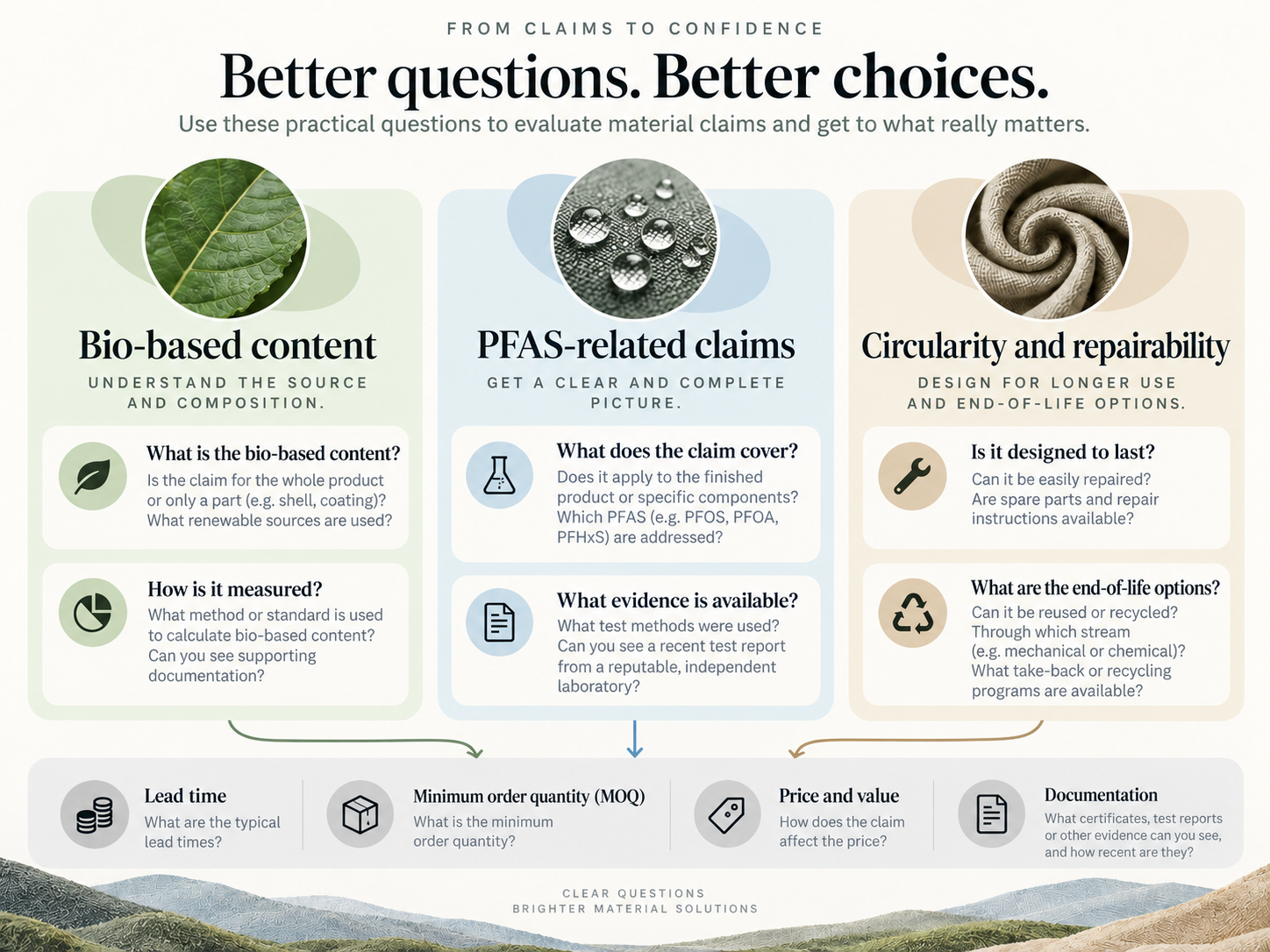
For a small collection, a one-page brief is often enough to make the first conversation useful. For example:
We're developing a lightweight weather-resistant jacket for daily travel and weekend walks. Our priorities are comfort over everyday clothing, reliable rain protection and a manageable first production run. Could you suggest appropriate constructions, send available samples and confirm composition, current test evidence, colour options, lead times and possible order quantities? Please specify which environmental claims are documented for the exact fabric.
There are no magic words here. If you do not know a target test value yet, say what the jacket needs to do and ask what should be measured. Compare the answers against your real product plan, not against the supplier with the longest sustainability paragraph.
A better way to use industry news
The October 2026 PERFORMANCE DAYS programme raised useful questions for buyers to investigate. It has not made every advertised new material ready for your product, nor does a programme establish what any exhibitor achieved.
If you're exploring options for a new collection, share your garment brief with SINJO and ask which constructions, test information and sampling questions can be discussed for your project. Availability and supplier-specific claims need checking before they become promises in your product description.
A couple of quick questions
Does PFAS-free mean a jacket is waterproof? No. Chemical-composition statements and water-resistance or waterproofness results need their own definitions and evidence.
Can a bio-based laminate also be recyclable? Possibly, but the two labels address different properties. Ask what parts of the material are covered and whether a credible end-of-life process is available for that construction.